Devil / Plague / Bride
Thinking about The House of the Devil, dir. Ti West, 2009; The Plague, dir. Charlie Polinger, 2025; and Attirement of the Bride, Max Ernst, 1940.
This week, a Satanic mood piece, a childhood nightmare, and a painting (medium spoilers for House of the Devil) . . .

From the Grave.
Three ideas from horror cinema's past.
◆ The House of the Devil, dir. Ti West, 2009.
- Immaculate vibes. The first (sudden, shocking) moment of violence in The House of the Devil comes at minute 37. The next depiction of violence comes at minute 64. The House of the Devil is a slow, slow burn, a feature that is built into its concept, which revolves around the onset and progression of a full lunar eclipse. But it isn’t slow, even though very little happens. Instead, it’s absorbing—courtesy of its handsomely staged, 80s aesthetic; Jocelin Donahue’s performance; evocative visuals (e.g. Donahue visible through a large window, alone in the cavernous, Victorian house); and just enough strangeness (together with that violent moment at minute 37) to keep tensions high. Its distinct appeal is as a feat of mood.
- Alone in the dark. We watch Donahue’s Samantha (functionally) alone in the house for a long stretch of The House of the Devil, and aloneness is a crucial aspect of the movie. Being alone can be scary, and we certainly feel that along with Samantha. It’s also freeing though, and Samantha does let loose—exploring, trying on a stray pair of glasses, tapping on a fish bowl (talking to the fish), and dancing around to The Fixx’s “One Thing Leads To Another.” These twin features of solitude—fear and freedom—are what lead Samantha to begin to catch on to the dire situation she’s found herself in. Her freedom to explore and her heightened sense of alertness make her something of a detective.
- On time. The House of the Devil stands out for its 1980s setting, a conceit that was less common in horror in 2009 than it is today. The period setting is doing a lot of stylistic and thematic work (more than can be unpacked here), motivating its 16mm format, its zoom-heavy style, and its cast—lead Donahue’s look recalls 80s casting aesthetics (she delivers a great performance too), and Tom Noonan and Mary Woronov are icons of 80s films (Noonan in Manhunter, Woronov in Eating Raoul and Chopping Mall). And for a film about devil worship, the 80s period puts it right in the middle of the Satanic panic. What occurred to me, further, was that the time period provided a useful quantum of space and freedom. The House of the Devil is a minimalist mood piece, and the 80s setting offers some distance from the norms and expectations of 2009. It's unclear what the reaction would be to this movie if it were set in the aughts. For its villains, precise timing (around the lunar eclipse) is everything. So too for its filmmakers.

Right Behind You.
A thought on horror's present.
◆ The Plague, dir. Charlie Polinger, 2025.
- Looking back. Charlie Polinger’s nightmarish, mesmerizing The Plague mines material that stands out for its familiarity—asking not “What if? . . .” but, rather, “Remember? . . .” It contains mere touches of fantasy (psychological phenomena made physical), locating horror in social experiences of childhood—particularly the cruel, mercurial systems of inclusion and ostracization among boys—that are entirely recognizable, even if we ourselves avoided the worst of it. The result points toward a horror of revisitation—a genre form especially harrowing because we understand its dark center so well.
Living Deliciously.
A recommendation.
◆ Attirement of the Bride, Max Ernst, 1940.
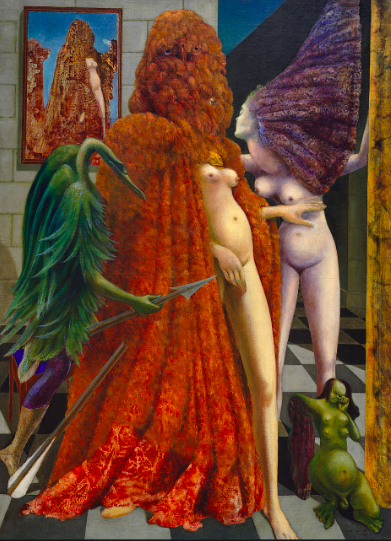
- Eye contact. I first encountered Max Ernst’s Attirement of the Bride/La Toilette de la mariée as an undergrad reading Janson’s History of Art and was lucky enough to see it in person last week. It's a horror image that rewards our attention. The scene depicted is both inviting and repellent, its figures uniformly hybrid—human and inhuman. There’s an eroticism in its nude forms and opulent colors and textures, but a sense of violence in its spear and lodged arrow, and an unsettling quality to its weird juxtapositions, its rough-surfaced double on the back wall, and the strange, little goblin in the corner. Attirement of the Bride is fundamentally indecipherable (at least in a clean, authoritative way), all its contrasting elements refusing to cohere, and there's a horror in indecipherability. Though there is, of course, comfort in the recognizable surrealism of the image. Ernst was not the only artist gathering elements like these into scenes of dreamlike unreality in the first half of the 20th century. Adding to the painting's resistance to coherence are the relationships among its figures. Their interactions are vague. There is one stark connection, though, in the stare out of the canvas by the central nude woman with the bird’s (owl's?) head. It’s difficult not to read an accusation in its gaze. As we attempt voyeuristically to interpret the scene, the bird-woman looks right back, suggesting one subject of Attirement of the Bride—us.
Dead of Night publishes every Tuesday. This is the third week of the strike of 2500 Starbucks workers across 85 cities demanding a fair contract. Tell your family and friends: No contract? No coffee. Don't buy Starbucks until the strike is over.